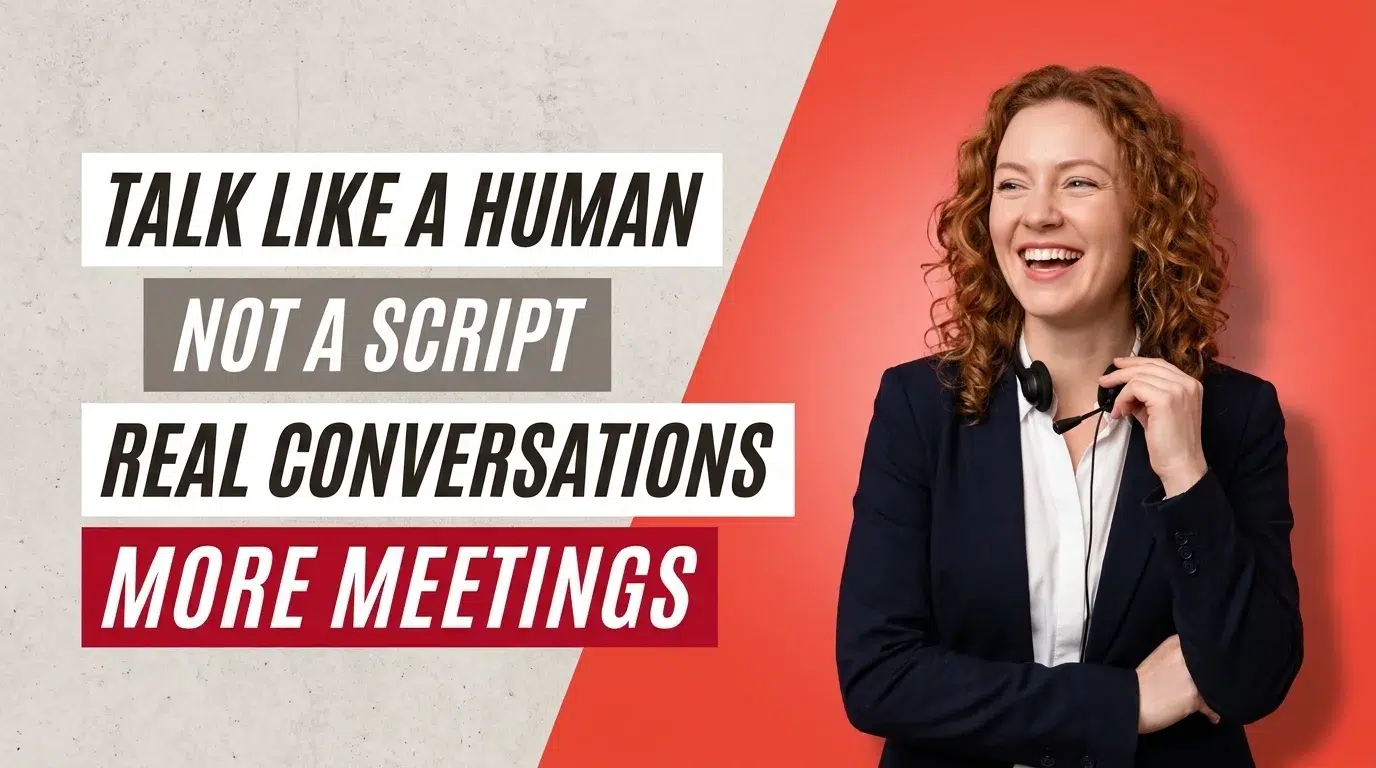
A word-for-word cold calling script creates two problems. The caller sounds like a recording, and the prospect’s answer rarely fits the next line. No script at all creates the opposite problem: key questions get missed, promises change from caller to caller and useful feedback disappears.
A good B2B cold calling script sits in the middle. It works as a framework: it sets the purpose, the opener, the questions, the objection paths and the next step, and still leaves room for a real conversation. Here’s how to build one.
Why robotic and unplanned calls both fail
Prospects decide fast whether a call feels relevant. A long company introduction, a hidden sales purpose or an instant meeting request makes the call feel like a waste of time.
Callers struggle too when they have no agreed way to answer common reactions. They improvise claims, argue with objections or hang up without recording why the prospect said no.
A framework should take away the guesswork without taking away judgement.
Start with the reason for the call
Before you write a single line, decide what the call is for and what a good next step looks like. That purpose comes from your ideal customer profile and the buying roles you plan to call.
The opener then has four short jobs:
- Say who you are and which company you’re with.
- Mention the account or role context that makes the call relevant.
- Give a clear, truthful reason for calling.
- Ask a short permission question so the prospect can continue or decline.
For example, the caller might explain that you work with a certain type of company on a certain process, then ask whether the prospect is the right person to talk to about it. The exact words must come from your real offer and approved claims.
Never pretend the call is a service notice, a referral or a follow-up to a conversation that didn’t happen. In the US, the FTC’s Telemarketing Sales Rule now bans misleading statements in B2B telemarketing calls too.
Use discovery questions to test fit
The first goal isn’t to list every feature. It’s to find out whether a real problem or project exists and whether this person has a role in the decision.
Pick a few open questions linked to the campaign:
- How is this handled today?
- What causes delay, cost or risk?
- Who else is involved in the decision?
- Is this a priority now, later or not at all?
- What would make a next conversation useful?
Listen before choosing the next question. The script is a map, not a form you fill in from top to bottom.
Plan cold calling objection handling, not rebuttals
An objection can mean poor fit, bad timing, missing trust or just a reflex to being interrupted. Good cold calling objection handling starts by working out which one it is.
“Not interested”
Accept the answer. If it fits, ask one short question to check whether it’s about relevance or timing. Stop when the prospect is clear.
“We already have a provider”
Don’t criticise the provider. Ask whether the current setup fully covers the problem you solve, and accept that a happy customer may mean there’s no opportunity.
“Send me some information”
Ask what would actually be useful, where to send it and whether a follow-up later is welcome. A generic brochure rarely helps the next conversation.
“I’m the wrong person”
Ask which team owns the issue, update the account map and avoid calling a string of unrelated people.
“Bad timing”
Check whether they want no more contact or a call at a specific later time. Record it so nobody else restarts the same sequence next week.
Define a qualified next step
A booked meeting is one good outcome, not the only one, and it shouldn’t be forced.
A qualified next step might be a discovery call with the right people, permission to send a relevant resource, a referral, a review date or a clear “not a fit”. Agree the minimum information needed before a call goes to sales: need, fit, timing, role, current approach, objection, agreed action and owner.
Capture every call as campaign learning
Keep call notes short and structured. Free-text notes alone make patterns hard to compare.
Use fixed outcome categories such as connected, qualified, nurture, referral, wrong fit, no answer, callback, do-not-call and data correction, plus a short note for the detail that changes the next action.
Then review patterns by segment. If one role keeps referring you elsewhere, the persona map may be wrong. If the offer needs too much explanation, the message or proof needs work. If numbers from one source keep failing, change the data rule.
Coordinate follow-up across channels
Email and LinkedIn can support a call when each channel has its own job. An email can deliver the promised resource. LinkedIn outreach can add professional context. A later call can answer a question.
Don’t repeat the same pitch on three channels on the same day. Keep one campaign record so everyone can see the last contact, the response and any stop request.
How we build cold calling scripts at CLG
We write the calling framework after the account and persona research. We help define the opener, discovery areas, common objection paths, outcome categories, attempt rules and the handover to sales.
Every campaign starts as a small pilot. Real conversations then improve the list, the cold call script and the follow-up plan before anyone talks about scaling. See how our B2B cold calling service works.
Cold calling script checklist
- Write down a truthful purpose and a qualified next step.
- Give each caller a short account brief.
- Use a short identity and relevance opener.
- Ask permission to continue where it fits.
- Choose discovery questions tied to the offer.
- Prepare respectful paths for common objections.
- Set stop rules and do-not-call handling.
- Record outcomes and route qualified next steps.
- Review call patterns before changing the script.
Frequently asked questions
What is a cold call script?
It’s a planned guide for a sales call to someone who hasn’t contacted you yet: the opener, the questions, the answers to common objections and the next step. In B2B, it works best as a flexible framework, not a word-for-word text.
How do you write a cold call script?
Start with the call’s purpose and your ICP, write a short truthful opener, pick four or five discovery questions, plan answers to the most common objections and define what counts as a good next step. Then test it on real calls and improve it.
Should a caller read the script word for word?
Usually not. Keep required disclosures, approved claims and key questions fixed, and let the caller listen and respond naturally.
Should every cold call ask for a meeting?
No. The next step should match the prospect’s fit and readiness. A referral, a useful follow-up or a clear no can be worth more than an unqualified meeting.
Can calls be recorded?
Only after you’ve agreed the method and checked the notice, consent and data rules for every market you call.
Turn your calls into real conversations
If your callers are stuck between rigid scripts and improvising, we can connect the research, the call framework, follow-up and handover into one pilot.